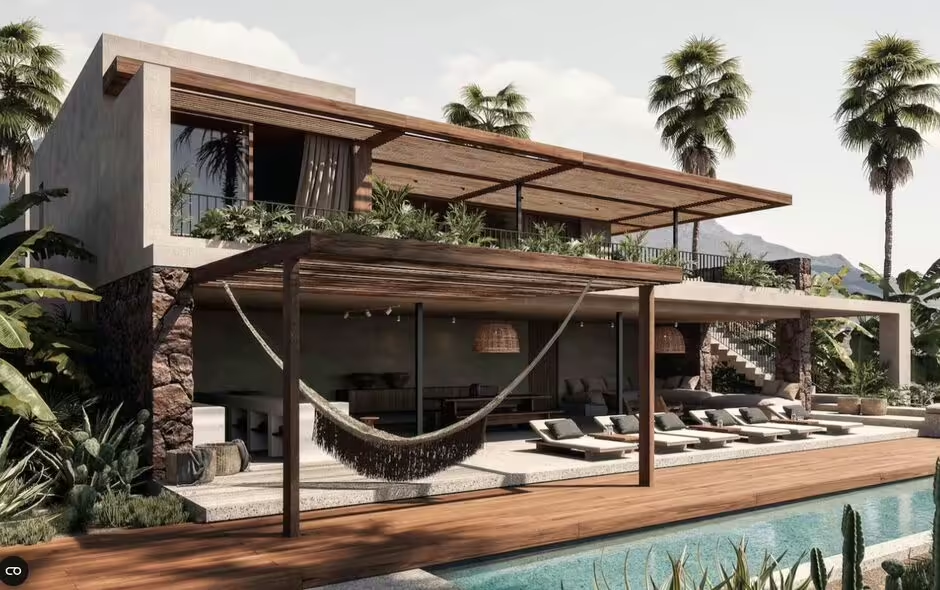
Tenerife’s new seaside resort environmental impact is already a hot topic – and if you care about where your holiday money goes, you’re right to pay attention. As someone who’s been in travel and digital marketing for 19 years, I’ve seen “dream projects” that genuinely uplift a destination… and others that quietly erode the very charm people came for in the first place.
In this article for Your Friend In Travel, I’ll walk you through what big coastal developments can mean for Tenerife’s environment, local communities, and your future holidays. I’ll also share practical tips on how to visit responsibly, plus some alternatives if you’d rather prioritise nature over another glossy complex.
Tenerife’s new seaside resort environmental impact: why it matters to you
Let’s start with the obvious question: why should you, as a traveller, care about Tenerife’s new seaside resort environmental impact?
Because developments of this scale don’t just add a few sun loungers and a cocktail bar. They can:
- Change the coastline – sometimes permanently
- Put pressure on local water and energy supplies
- Push up prices for locals, workers, and even future visitors
- Shift a place from “authentic and relaxed” to “polished and crowded” within a few seasons
I remember visiting a small bay in southern Spain in my early twenties. The first time, it was a sleepy fishing area with one chiringuito (beach bar) and a handful of rooms over a family-run restaurant. A few years later, a new “eco‑styled” resort had appeared on the cliffs. On paper, it sounded amazing. In reality, the water was rationed in the village during peak season, and you suddenly needed to book restaurants weeks in advance.
Tenerife is at a similar crossroads in some coastal areas. If you love the island for its volcanic character, natural pools, and rough‑around‑the‑edges charm, then understanding the environmental impact of new seaside resorts is part of protecting the holidays you actually want.
How large seaside resorts affect Tenerife’s coastline
Whenever a new resort is built right on the coast, the first victim is often the shoreline itself.
Here’s what typically happens when you put a big complex on or near a natural bay:
- Habitat loss: Rocky coves, dunes, and scrubland are bulldozed or built over. These aren’t “wastelands” – they’re home to plants, birds, and insects adapted to Canary Island conditions.
- Coastal engineering: Sea walls, jetties, artificial beaches, and marinas can change how waves and sand move. That can mean more erosion for one beach, more sediment clogging another.
- Light and noise pollution: What used to be a dark, quiet bay at night becomes a lit-up party strip or at least a permanently glowing resort edge. That affects everything from nesting birds to marine life drawn off course.
On one research trip a few years back, I stood on a clifftop above a “newly improved” bay. The resort’s pool lights were so bright they reflected off the sea like a mini city. Beautiful in one sense, but if you turned around and looked inland, the old village sat in relative darkness, as it always had. Two very different worlds sharing the same tiny stretch of coast.
In Tenerife, where much of the attraction lies in volcanic rock pools, rugged cliffs, and clear water, those modifications can slowly change what future visitors see and feel.
Water, energy and waste: the hidden cost of your infinity pool
Tenerife is not a place of endless rivers and lakes. It’s a volcanic island, and water is precious. When you’re told a resort has “several pools, landscaped gardens, and a full spa”, it sounds like heaven. But each of those features consumes resources the island has to provide.
Key pressures from big resort developments:
- Water consumption
Resort pools, daily linen changes, spas, irrigated lawns, and lush gardens use an enormous amount of water. On an island with limited natural freshwater, this often means extra strain on desalination plants and existing infrastructure. - Energy demand
Air conditioning, heating pools, running lifts, lighting large complexes all day and night – energy demand shoots up. If the resort isn’t genuinely investing in renewables, that means higher emissions and more pressure on the island’s energy grid. - Waste generation
Think of buffet waste, single-use plastics, cleaning chemicals, and general rubbish from thousands of guests. Even if some is recycled, a lot still needs to be transported and processed, adding to local landfill pressures and emissions.
I once visited a Canarian hotel that boasted about “towel reuse” to save water, but they were also refilling ornamental fountains all day in the middle of August. That’s a classic example of surface-level “green” gestures not matching the reality of the operation behind the scenes.
When you think about Tenerife’s new seaside resort environmental impact, don’t just picture the building – picture the ongoing daily demand to keep that building running like a small town.
Local communities: who wins and who gets squeezed?
It’s easy to assume a new resort is automatically “good for the local economy”. The truth is more nuanced.
Yes, there are potential benefits:
- Construction jobs during the build phase
- Hospitality and service jobs once open
- More customers for some nearby businesses
- More tax income for local authorities (in theory, at least)
But there are also costs that locals often feel first:
- Rising rents and property prices: Workers and residents can be priced out of their own neighbourhoods as an area becomes “hot” for investment and short‑term lets.
- Shift in business focus: Local shops that once served residents switch to tourist‑oriented offerings – souvenirs, cocktails, and high‑margin experiences. Everyday services get pushed further out.
- Seasonal, lower‑paid jobs: Many of the new roles are seasonal, repetitive, and not especially well paid, with limited career progression unless you get into management.
I remember talking to a bar owner in the Canaries who’d been there for decades. He said, “The new resort guests don’t walk our streets. They stay inside the complex, eat there, drink there. We see more delivery vans than tourists these days.” That stuck with me.
From a travel perspective, this matters because it shapes the type of destination you’ll encounter. Will you be walking through a real town with bakeries, hardware shops, and locals lingering over coffee? Or a heavily curated resort bubble where everything is convenient but feels oddly interchangeable with any other sunny resort worldwide?
If you care about Tenerife’s character, you need to care about the social side of these developments as well.
“Eco” or just eco-sounding? How to read resort marketing claims
One of the biggest challenges when discussing Tenerife’s new seaside resort environmental impact is that many projects use “nature” and “sustainability” heavily in their marketing. You’ll see phrases like:
- “Reconnect with nature”
- “Eco-inspired design”
- “Organic restaurant”
- “Wellness in harmony with the environment”
None of those phrases, on their own, proves the resort is environmentally responsible.
Over the last 19 years, I’ve developed a simple mental checklist when a coastal project claims to be sustainable. You can use it too:
- Independent environmental assessment
Has the project undergone a thorough, independent environmental impact study? Were the results made public? Were any recommendations actually implemented, not just acknowledged? - Scale and density
Is it a relatively small, low‑rise development that fits into the terrain, or a high‑density “mini city” with thousands of beds? Bigger is almost always harder to manage sustainably. - Water and energy systems
Does the resort publish clear information on how it handles water (recycling, desalination, efficiency) and how much of its energy comes from renewables? “We care about the planet” is not a plan. - Support for local economy
Is there any sign of long-term partnership with nearby communities – hiring, training, sourcing local produce, promoting local tours – or is it a mostly closed loop where guests spend 90% of their money inside the resort? - Protection of surrounding nature
Do they mention protecting existing habitats, avoiding building right on fragile dunes or cliffs, or funding local conservation work?
When resorts tick several of these boxes with specifics (not just pretty words), I’m more willing to give them the benefit of the doubt. When they don’t, nature is usually just part of the décor.
How Tenerife’s tourism model is shifting – and what that means for your trips
Tenerife has long been known for affordable package holidays, especially in the south. Over time, though, there’s been a clear shift toward higher-spend tourism: luxury hotels, golf resorts, wellness complexes, and now new seaside projects positioned as upscale destinations.
This shift has three big implications for travellers:
- Prices will likely trend upwards
As more luxury stock comes online, mid‑range options nearby often creep up in price. It’s not immediate, but it happens. You might notice that a three‑star hotel you used to book suddenly feels less of a bargain. - Crowds may concentrate in certain areas
New resorts draw more visitors to specific bays, especially if they become Instagram favourites. That can mean more traffic, busier car parks, and packed beaches in what were once relatively quiet corners. - Other areas stay more “authentic” – for now
The upside is that there are still parts of Tenerife – especially in the north and inland – where tourism is more low‑key and intertwined with local life. These areas can benefit when travellers actively choose smaller guesthouses, rural stays, and family‑run hotels.
If you’re a regular visitor, this is the time to be intentional about where you stay. Instead of defaulting to the newest shiny complex, ask yourself:
- Do I want a polished, all‑in experience, or do I want to feel like I’m actually in Tenerife, not just “somewhere sunny”?
- Am I okay with my money mostly staying inside one corporate structure, or do I want it to circulate more locally?
Your choices, multiplied by thousands of visitors, help shape how the island evolves.
How to visit Tenerife responsibly when big resorts are moving in
You don’t need to boycott Tenerife or feel guilty for wanting a pool and a comfy bed. The key is to travel with a bit more awareness and intention.
Here are practical ways to reduce your personal contribution to negative environmental impact – even if you stay in or near a large seaside resort:
- Choose your base carefully
Consider staying slightly away from the biggest new developments – maybe in a smaller hotel, apartment, or rural house that spreads visitor numbers more evenly across the island. - Support local businesses
Even if you stay in a resort, make time to eat at local restaurants, shop at local markets, and join tours run by Tenerife‑based guides. That helps keep communities viable beyond the resort gates. - Be mindful of water and energy use
Take shorter showers, reuse towels, and turn off air conditioning when you’re out. It sounds basic, but in a place where thousands of people are doing the opposite, it makes more difference than you think. - Pick responsible excursions
When booking whale‑watching, hiking, or marine activities, choose operators who talk about conservation, respect for wildlife, and small group sizes. Read reviews with an eye on how they treat the environment, not just how “fun” the trip was. - Explore beyond the “resort zone”
Use public transport or shared excursions to see other parts of Tenerife – Anaga, Teide National Park, Garachico, La Orotava. Spreading your presence and spending helps balance out intense pressure in just a few seaside spots.
Over the years, I’ve noticed that the trips I remember most aren’t the ones where I stayed by the same pool for a week. They’re the ones where I chatted to a local café owner, got lost in a backstreet, or found a half‑empty mirador at sunset. Responsible travel and memorable travel often go hand in hand.
Conclusion: your choices shape Tenerife’s future
Tenerife’s new seaside resort environmental impact is not just a technical planning issue – it’s a question of what kind of island you want to visit in 5, 10, or 20 years.
- Do you want a coastline dominated by large, “world‑class” complexes where every comfort is available, but nature is something you photograph from the infinity pool?
- Or do you want Tenerife to remain a place where you can still find wild coves, small family‑run stays, and a genuine sense of being somewhere unique?
Neither option is entirely black and white. Resorts can bring jobs and investment; unchecked development can hollow out both the environment and local life. Your power lies in where you stay, how you spend, and how curious you are about the island beyond the brochures.
If you found this helpful and you want more honest, experience‑based advice like this, stick with Your Friend In Travel. Subscribe, share this with someone planning a Tenerife trip, and feel free to ask me specific questions about areas or types of stays – I’m always happy to help you find options that suit both you and the island.
FAQs about Tenerife’s new seaside resort environmental impact
1. Is it still worth visiting Tenerife with all these new resorts being built?
Yes, absolutely. Tenerife is a big, diverse island with plenty of areas that remain relatively untouched by large-scale development. The key is choosing your base carefully and being mindful about how you spend your time and money. You can still have an amazing holiday while supporting the parts of the island that prioritise nature and community.
2. How can I tell if a Tenerife resort is genuinely eco-friendly?
Look beyond the marketing words. Check for clear information about water use, energy sources, waste management, and any independent environmental certifications. See if they mention supporting local suppliers and communities in a concrete way. Vague statements like “we care about the environment” without specifics are a red flag.
3. Are smaller guesthouses and apartments better for the environment than big resorts?
Not always automatically, but they often have a smaller footprint and use fewer resources than massive complexes. They can also spread visitors across different neighbourhoods instead of concentrating everyone in one overloaded bay. Reading reviews and checking how they talk about energy, water, and waste can help you decide.
4. Will new seaside resorts make Tenerife more expensive for visitors?
Over time, large upscale developments tend to push prices upward in nearby areas, both for accommodation and sometimes for food and activities. That doesn’t mean Tenerife will suddenly become unaffordable, but you may need to be more strategic about where you stay (for example, considering the north or inland towns if you’re on a tighter budget).
5. What’s one simple thing I can do to travel more responsibly in Tenerife?
If you only do one thing, make a point of spending at least some of your dining and activity budget with locally owned businesses outside your accommodation complex. That single habit supports real families, helps maintain authentic neighbourhoods, and sends a clear signal that visitors value more than just the resort bubble.
About the Author